- adopted to review comments
- removed the role from layouts
- reworked the Groups within the layouts
- added more documentation
- rebased to latest changes
- Fix tgogenerator
- Fix UI for ForceGroup and Layouts
- Fix ammo depot handling
- Split bigger files in smaller meaningful files (TGO, layouts, forces)
- Renamed Template to Layout
- Renamed GroundGroup to TheaterGroup and GroundUnit to TheaterUnit
- Reorganize Layouts and UnitGroups to a ArmedForces class and ForceGroup similar to the AirWing and Squadron
- Reworded the UnitClass, GroupRole, GroupTask (adopted to PEP8) and reworked the connection from Role and Task
- added comments
- added missing unit classes
- added temp workaround for missing classes
- add repariable property to TheaterUnit
- Review and Cleanup

Added serialization for loaded templates

Loading the templates from the .miz files takes a lot of computation time and in the future there will be more templates added to the system. Therefore a local pickle serialization for the loaded templates was re-added:
- The pickle will be created the first time the TemplateLoader will be accessed
- Pickle is stored in Liberation SaveDir
- Added UI option to (re-)import templates
Improvement for factions and templates which will allow decoupling of the templates from the actual units
- Implement UnitGroup class which matches unit_types and possible templates as the needed abstraction layer for decoupling.
- Refactor UnitType, Add ShipUnitType and all ships we currently use
- Remove serialized template.json and migrated to multiple yaml templates (one for each template) and multiple .miz
- Reorganized a lot of templates and started with generalization of many types (AAA, Flak, SHORAD, Navy)
- Fixed a lot of bugs from the previous reworks (group name generation, strike targets...)
- Reorganized the faction file completly. removed redundant lists, added presets for complex groups / families of units like sams
- Reworked the building template handling. Some templates are unused like "village"
- Reworked how groups from templates can be merged again for the dcs group creation (e.g. the skynet plugin requires them to be in the same group)
- Allow to define alternative tasks
- Factored out the current generators to use a better approach with Templates build from the dcs mission editor.
- This information is extended with a template-mapping in a json file which allows to logically group together multiple dcs groups and even statics to one template
- The combination of mapping and miz will be serialized to a template.json which is only used for loading.
- Factions now load templates during initialization and hold all the templates they can really use. This is based around the faction file.
- Implemented a template randomizer which allows to add some randomization to templates
- Each Template Group can have 1 randomizer which randomizes unit_type and size based on the mapping definition. Larger groups need to be devided in more fine detailed groups as we can now handle them better due to the change from dcs group types to our own classes.
- Rewritten the ArmorGroup, Naval and EWR template handling

Rework GroundObjectBuyMenu to support templates
- completly refactored the way TGO handles groups and replaced the usage of the pydcs ground groups (vehicle, ship, static) with an own Group and Unit class.
- this allows us to only take care of dcs group generation during miz generation, where it should have always been.
- We can now have any type of unit (even statics) in the same logic ground group we handle in liberation. this is independent from the dcs group handling. the dcs group will only be genarted when takeoff is pressed.
- Refactored the unitmap and the scenery object handling to adopt to changes that now TGOs can hold all Units we want.
- Cleaned up many many many lines of uneeded hacks to build stuff around dcs groups.
- Removed IDs for TGOs as the names we generate are unique and for liberation to work we need no ids. Unique IDs for dcs will be generated for the units and groups only.
- removed the map_object_id from the TGO
- add a new TriggerRule with the MapObjectIsDead Condition which adds the map object to the killed_map_objects array in the state.json
- Use the trigger_zone_name as the unique identifier used for the unit_map to recognize the kill
This doesn't do anything yet, but sets up the data model handling for
frozen combat. The next step is to show combat in the map view, since
that will be helpful when debugging the step after that one: resolving
frozen combat.

This would benefit from caching the Shapely data for SAM threat zones.
Right now it's generating them once per tick and the stuttering is
visible at max speed.

https://github.com/dcs-liberation/dcs_liberation/issues/1680
* Initial refueling definitions.

* Adding refuel definitions.

* Initial functionality changes

* Regenerate package when adding refueling flight.

* Recursively change package waypoint.

* Fix mypy errors.

* Regenerate flight plans when tanker is added to package.

* Give tanker better starting position on package recovery.

* Add TOT calculation for refueling waypoint.

* Timing changes to Strike split point and Refueling start time.

* Add correct waypoint builder for refuel in tarcap and sweep.  Remove restrict afterburner on refuel point.

* Always generate a refuel point for a package.

* Less arbitrary altitude in Refuel track start time calculation.

* Refueling waypoint no longer optional.

* Fix mypy gen error.

* Better discrimination of which tanker flight plan to make.

* Remove refuel tot calculations.

* Remove package regeneration on tanker flight addition.
* Addresses #478, adding a heading class to represent headings and angles
Removed some unused code

* Fixing bad merge

* Formatting

* Fixing type issues and other merge resolution misses
An HTN (https://en.wikipedia.org/wiki/Hierarchical_task_network) is
similar to a decision tree, but it is able to reset to an earlier stage
if a subtask fails and tasks are able to account for the changes in
world state caused by earlier tasks.

Currently this just uses exactly the same strategy as before so we can
prove the system, but it should make it simpler to improve on task
planning.
This is as much as we can do until pydcs actually adds the py.typed
file. Once that's added there are a few ugly monkey patching corners
that will just need `# type: ignore` for now, but we can't pre-add those
since we have mypy warning us about superfluous ignore comments.
- added information about the role of the aa site
- moved handling of ground name from tgo to the sam generator to make the tgo cleaner
- adjusted the skynet-config lua to the changes
Target the air defenses whose *threat ranges* come closest to friendly
bases rather than the closest sites themselves. In other words, the
SA-10 that is 5 miles behind the SA-6 will now be the priority.

This also treats EWRs a bit differently. If they are not protected by a
SAM their detection range will be used for determining their "threat"
range. Otherwise a heuristic is used to determine whether or not they
can be safely attacked without encroaching on the covering SAM.
We don't need to include a SEAD flight in missions against EWRs or SAMs
that no longer have a radar.

Also plan DEAD missions against air defenses that have no radars.
Previously we would never finish killing launcher only sites (which
cannot defend any more, but are cheaper to return to working order than
a fully destroyed site) nor would we plan DEAD against IR SAMs or AAA.
We were setting up all the correct *target* waypoints but the AI doesn't
use the target waypoints; they use the targets property of the ingress
waypoint. This meant that the flight plan looked correct in the UI and
was correct for players but the tasks were set up incorrectly for the AI
because building TGOs are aggravatingly multiple TGOs with the same name
in the implementation.

Mission targets now enumerate their own strike targets so that this
mistake is harder to make in the future.

This won't be perfect, the AI is still not able to parallelize tasks and
since buildings aren't groups they can only attack one structure at a
time, but they'll now at least switch to the next target after hitting
the first one.

As a bonus, stop bombing the dead buildings.

Fixes https://github.com/dcs-liberation/dcs_liberation/issues/235
Fixes https://github.com/dcs-liberation/dcs_liberation/issues/244
This really needs to be a proper type, but this is a start: create new
categories for the types of TGOs that are missing. This removes some
icon special cases.
These are an implementation quirk, and passing them to the UI just means
that we put TGO pins on top of the CP, which makes the base menu
unopenable.

In the old UI we avoided this by not drawing anything that was
`for_airbase`, but now that we can zoom in further we're drawing base
defenses.
This PR allows campaign creators to incorporate map objects (referred to as Scenery in the code) into their Liberation campaign.
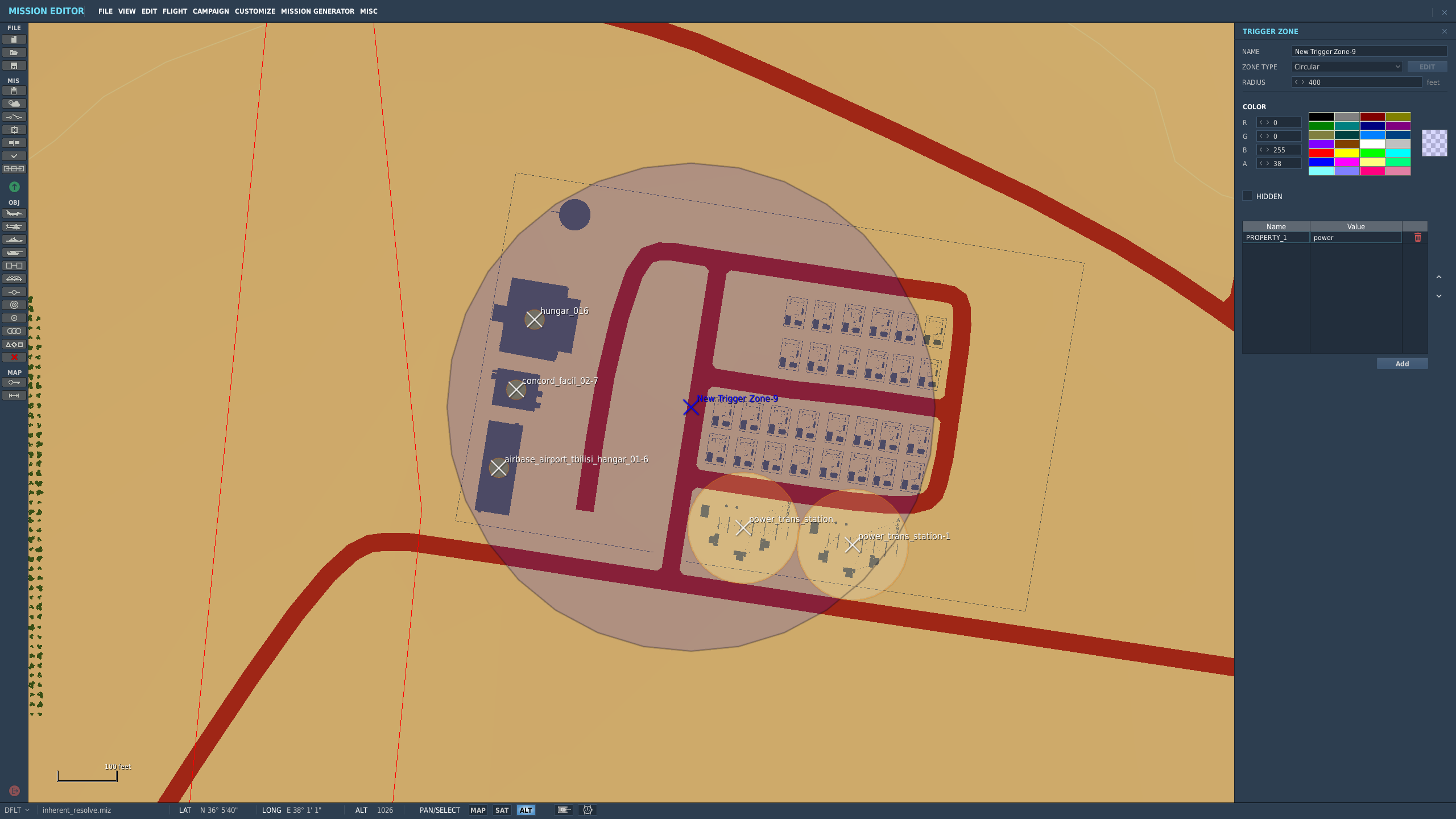
Map objects are defined using white trigger zones created by right clicking on scenery and clicking `assign as...`. Objective groups are defined by creating a blue TriggerZone surrounding the centers of the white trigger zones. The type of objective is determined by the campaign creator, assigning the value of the first property of the blue TriggerZone with the objective type.
Map objects maintain their visually dead state by assigning a `Mission Start` `Scenery Object Dead` trigger to the trigger zone. It is important for the Liberation generated TriggerZone to be as small as possible so that no other scenery is marked dead by DCS.
TriggerZones are hidden during gameplay (DCS behavior. I don't know if it's possible to turn that off.) TriggerZones are visible in the mission editor and mission planner however. If a player is using an older plane, it is important for them to remember where the target is.
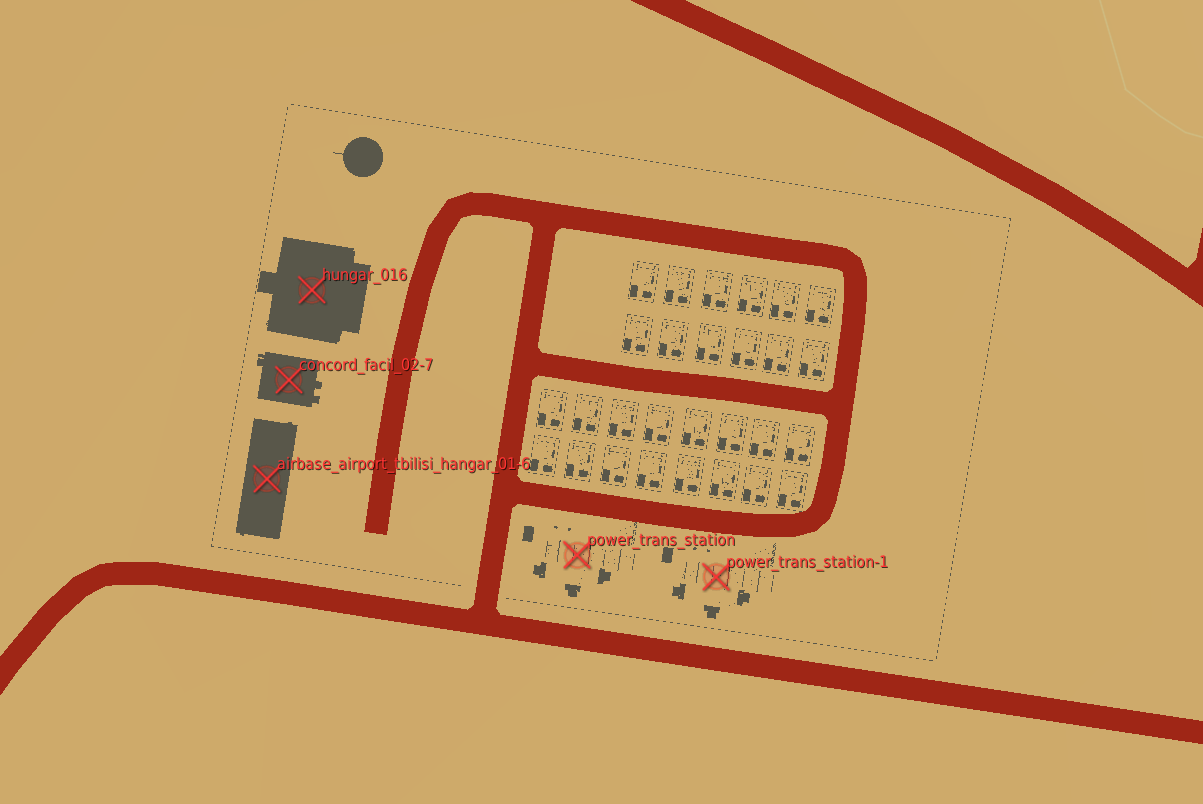
In the mission planner, the trigger zones' will be blue or red depending on which faction the map objects belong to.
Inherent Resolve campaign has been modified to integrate scenery objects.
### **Limitations:**
- Objective definitions (Any Blue TriggerZones) in campaign definition cannot overlap.
- Map object deaths in `state.json` is tracking integers. You won't know what died until debriefing.
- No images for the various buildings. In theory it can be done, but an unreasonable amount of work.
- Every blue trigger zone must have a unique name. (If you let DCS auto increment the names this is not a concern.
- No output to screen when scenery object is dead. You can see the building drawn as dead in the F10 map though.
### **Pictures:**
An objective:
How the objective looks once in the mission planner/editor. This objective belongs to the enemy faction:
The `FactoryGroundObject` is just a special case of
`BuildingGroundObject` that we maybe don't actually need. For now it
provides some special case logic for the layout, but this allows any TGO
with the "factory" category to behave as a ground unit source.

Note that the "factory" random strike targets are *not* generated
anymore, so this doesn't affect campaign design currently.
This also removes the "factory" type from the normal strike target
(money generating) generators to avoid confusion. Later only control
points with factories will be able to spawn ground units, at which point
these will no longer generate income.

https://github.com/Khopa/dcs_liberation/issues/986
* A Bluefor EWR 55GS in the campaign miz defines an optional EWR site. There is no distinction between how close or far it is to a base, so it's possible that there will be many EWRs within an airbase.
* A Redfor EWR 1L13 in the campaign miz defines a required EWR site.

It would be a good future idea to limit the amount of EWRs within a certain distance from an airbase. That way there's no chance of 5 EWRs all at the same airbase. Even better if there were something preventing any two EWRs from being right next to each other.

No campaigns take advantage of this yet.

Fixes https://github.com/Khopa/dcs_liberation/issues/524
We were never resetting the dead state for repaired SAMs. Rather than
tracking that manually, determine liveness from the number of units left
alive.

For building objectives where the group is not assigned to the TGO until
*mission* generation time we still need manual tracking.
Some SAMs have multiple groups (such as an SA-10 group with its
accompanying SA-15 and SA-19 groups). This shows each group's threat and
detection separately on the map, and also makes it so that an SA-10 with
dead radars will no longer contribute to the threat zone just because
the shilka next to it still has a functioning radar.

https://github.com/Khopa/dcs_liberation/issues/647
Fixes https://github.com/Khopa/dcs_liberation/issues/672


