The AI purchaser will aim to have a 50/50 ground/air investment mix.
This allows it to overspend on one category if significant losses were
taken the previous turn.

The total purchase amount is still limited, so if the bases are full
when only 10% of the investment is in ground units, the full budget for
the turn will still go to air.
The usual symptom here was the game breaking when a carrier is
destroyed. The carrier would no longer be operational but missions would
be assigned there that could not generate flight plans.
Unit composition is defined by the doctrine. The most understaffed CP
will now get the most underrepresented unit type. Previously a random
understaffed CP would get a random unit type.

Fixes https://github.com/dcs-liberation/dcs_liberation/issues/1057.
This limit is determined by the number of buildings that belong to Ammo
Depots at the front line's connected Control Point. The limit increases
for every surviving building at ammo depot objectives.

There is a lower limit to the number of units that will spawn, so that
if there are no surviving ammo depot buildings at a control point, there
will still be some ground conflict.
Target the air defenses whose *threat ranges* come closest to friendly
bases rather than the closest sites themselves. In other words, the
SA-10 that is 5 miles behind the SA-6 will now be the priority.

This also treats EWRs a bit differently. If they are not protected by a
SAM their detection range will be used for determining their "threat"
range. Otherwise a heuristic is used to determine whether or not they
can be safely attacked without encroaching on the covering SAM.
DMS with decimal seconds is what the hornet uses for PP targest. In the
future we'll want to make this aircraft specific (and potentially user
preference for jets like the A-10 that can handle both L/L and MGRS).
We don't need to include a SEAD flight in missions against EWRs or SAMs
that no longer have a radar.

Also plan DEAD missions against air defenses that have no radars.
Previously we would never finish killing launcher only sites (which
cannot defend any more, but are cheaper to return to working order than
a fully destroyed site) nor would we plan DEAD against IR SAMs or AAA.
We were setting up all the correct *target* waypoints but the AI doesn't
use the target waypoints; they use the targets property of the ingress
waypoint. This meant that the flight plan looked correct in the UI and
was correct for players but the tasks were set up incorrectly for the AI
because building TGOs are aggravatingly multiple TGOs with the same name
in the implementation.

Mission targets now enumerate their own strike targets so that this
mistake is harder to make in the future.

This won't be perfect, the AI is still not able to parallelize tasks and
since buildings aren't groups they can only attack one structure at a
time, but they'll now at least switch to the next target after hitting
the first one.

As a bonus, stop bombing the dead buildings.

Fixes https://github.com/dcs-liberation/dcs_liberation/issues/235
Fixes https://github.com/dcs-liberation/dcs_liberation/issues/244
This really needs to be a proper type, but this is a start: create new
categories for the types of TGOs that are missing. This removes some
icon special cases.
These are an implementation quirk, and passing them to the UI just means
that we put TGO pins on top of the CP, which makes the base menu
unopenable.

In the old UI we avoided this by not drawing anything that was
`for_airbase`, but now that we can zoom in further we're drawing base
defenses.
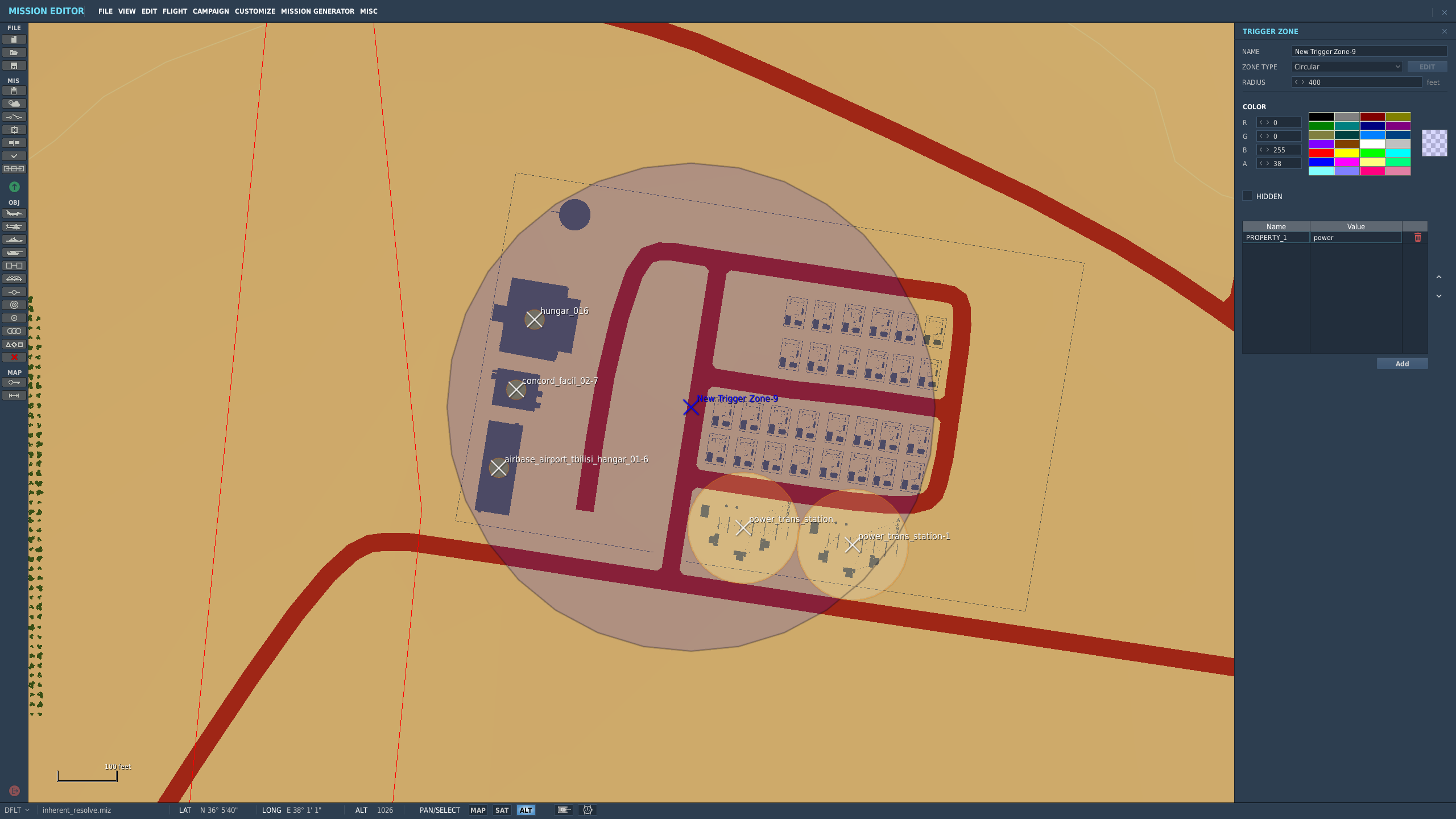
This PR allows campaign creators to incorporate map objects (referred to as Scenery in the code) into their Liberation campaign.
Map objects are defined using white trigger zones created by right clicking on scenery and clicking `assign as...`. Objective groups are defined by creating a blue TriggerZone surrounding the centers of the white trigger zones. The type of objective is determined by the campaign creator, assigning the value of the first property of the blue TriggerZone with the objective type.
Map objects maintain their visually dead state by assigning a `Mission Start` `Scenery Object Dead` trigger to the trigger zone. It is important for the Liberation generated TriggerZone to be as small as possible so that no other scenery is marked dead by DCS.
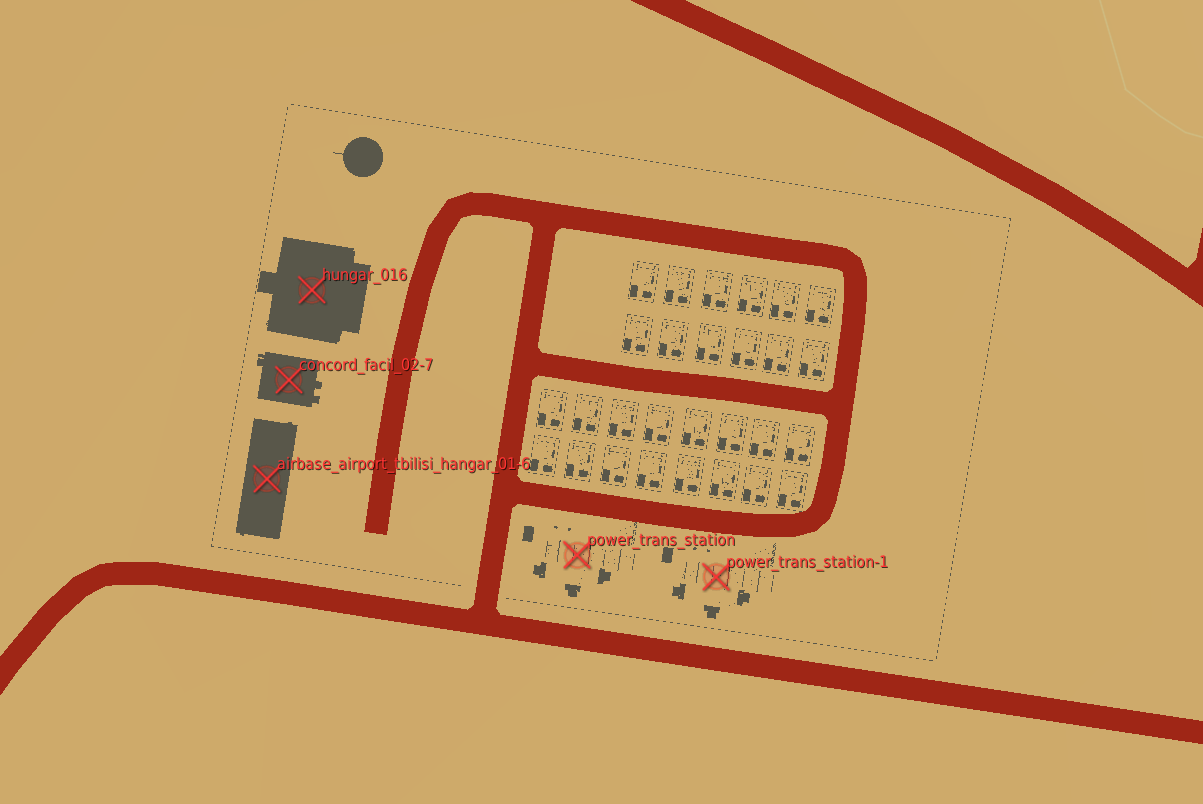
TriggerZones are hidden during gameplay (DCS behavior. I don't know if it's possible to turn that off.) TriggerZones are visible in the mission editor and mission planner however. If a player is using an older plane, it is important for them to remember where the target is.
In the mission planner, the trigger zones' will be blue or red depending on which faction the map objects belong to.
Inherent Resolve campaign has been modified to integrate scenery objects.
### **Limitations:**
- Objective definitions (Any Blue TriggerZones) in campaign definition cannot overlap.
- Map object deaths in `state.json` is tracking integers. You won't know what died until debriefing.
- No images for the various buildings. In theory it can be done, but an unreasonable amount of work.
- Every blue trigger zone must have a unique name. (If you let DCS auto increment the names this is not a concern.
- No output to screen when scenery object is dead. You can see the building drawn as dead in the F10 map though.
### **Pictures:**
An objective:
How the objective looks once in the mission planner/editor. This objective belongs to the enemy faction:
The `FactoryGroundObject` is just a special case of
`BuildingGroundObject` that we maybe don't actually need. For now it
provides some special case logic for the layout, but this allows any TGO
with the "factory" category to behave as a ground unit source.

Note that the "factory" random strike targets are *not* generated
anymore, so this doesn't affect campaign design currently.


