The priority list was guiding the purchase decision which largely meant
that this was working correctly, but there were suboptimal cases where
the list was being taken in FIFO order by purchased type. This fixes the
search to be locally optimal, although this does still mean that a worse
but closer aircraft will be chosen over a better but slightly farther
away aircraft. We'd need to have a quality vs distance rating to do
better.

Fixes https://github.com/dcs-liberation/dcs_liberation/issues/755
We were accidentally iterating over the faction list and checking it
against the priority list rather than the other way around, so the
faction's aircraft list was being used for purchase priority rather than
the actual priority list in the game.
Many of the schema version increases are just to add new features that
don't render old campaigns obsolete. Convert the version number to a
major/minor format so we can detect the difference between changes that
render old campaigns obsolete (major versions) and new features that
will not work on older builds of Liberation (minor versions).
Loadout selection no longer has two (disagreeing) implementations. What
the UI shows is now what the miz will have.

We now store the chosen layout in the Flight *always*, not just for
custom loadouts. This means that we do loadout lookups at the start of
each turn, but the data is cached in pydcs.

Era-specific loadout degradation is still done at generation (and
presentation) time. This is so that players can toggle that option and
have it affect the *current* turn, rather than the next one.
These are an implementation quirk, and passing them to the UI just means
that we put TGO pins on top of the CP, which makes the base menu
unopenable.

In the old UI we avoided this by not drawing anything that was
`for_airbase`, but now that we can zoom in further we're drawing base
defenses.
This PR allows campaign creators to incorporate map objects (referred to as Scenery in the code) into their Liberation campaign.
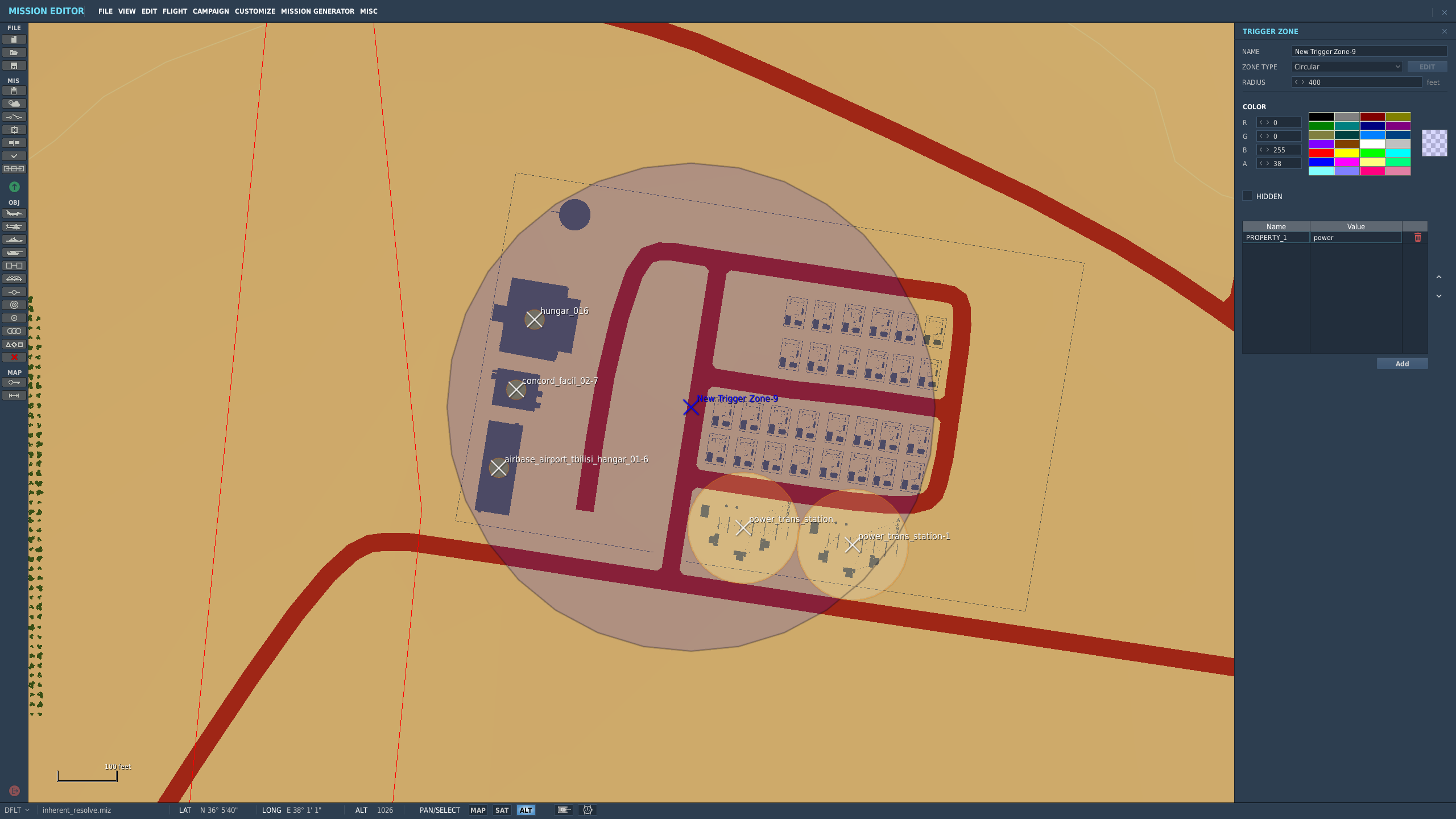
Map objects are defined using white trigger zones created by right clicking on scenery and clicking `assign as...`. Objective groups are defined by creating a blue TriggerZone surrounding the centers of the white trigger zones. The type of objective is determined by the campaign creator, assigning the value of the first property of the blue TriggerZone with the objective type.
Map objects maintain their visually dead state by assigning a `Mission Start` `Scenery Object Dead` trigger to the trigger zone. It is important for the Liberation generated TriggerZone to be as small as possible so that no other scenery is marked dead by DCS.
TriggerZones are hidden during gameplay (DCS behavior. I don't know if it's possible to turn that off.) TriggerZones are visible in the mission editor and mission planner however. If a player is using an older plane, it is important for them to remember where the target is.
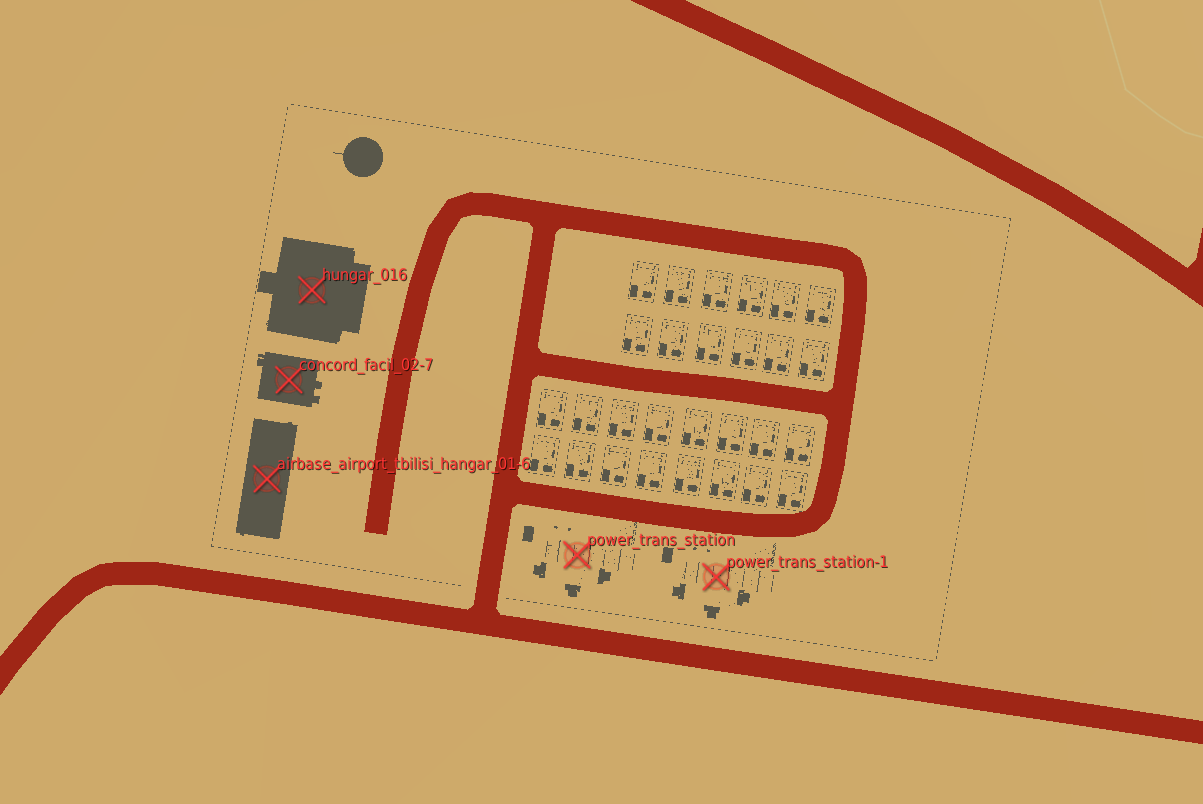
In the mission planner, the trigger zones' will be blue or red depending on which faction the map objects belong to.
Inherent Resolve campaign has been modified to integrate scenery objects.
### **Limitations:**
- Objective definitions (Any Blue TriggerZones) in campaign definition cannot overlap.
- Map object deaths in `state.json` is tracking integers. You won't know what died until debriefing.
- No images for the various buildings. In theory it can be done, but an unreasonable amount of work.
- Every blue trigger zone must have a unique name. (If you let DCS auto increment the names this is not a concern.
- No output to screen when scenery object is dead. You can see the building drawn as dead in the F10 map though.
### **Pictures:**
An objective:
How the objective looks once in the mission planner/editor. This objective belongs to the enemy faction:
To avoid confusion, use only the aircraft list for the purchasable
aircraft. This fix also caught a faction's Tu-142 that was not actually
purchasable. Invalid aircraft in the faction aircraft list will now
raise an error.

Fixes https://github.com/dcs-liberation/dcs_liberation/issues/1074
The `FactoryGroundObject` is just a special case of
`BuildingGroundObject` that we maybe don't actually need. For now it
provides some special case logic for the layout, but this allows any TGO
with the "factory" category to behave as a ground unit source.

Note that the "factory" random strike targets are *not* generated
anymore, so this doesn't affect campaign design currently.
The routes do not need be be recreated each time we create a
`FrontLine`. The front lines follow the convoy routes, which are static.
Add the convoy route data to the `ControlPoint` the way we do for
shipping lanes and have `FrontLine` load the data from there.
A was intended to be the blue point and B was intended to be the red
point. Make this a part of the name so that's clear, and clean up
related code to keep that reliable.
Some of the objective locations for the starting front line are too
aggressive and put opfor at a disadvantage since blue ships might start
so close to their bases.
No sense filling airbases with cheap escorts if we'll never afford the
rest of the package. Filling the airbases with cheap escorts also makes
it impossible to buy the rest of the package when the faction eventually
does have the money since there's nowhere to park the needed aircraft.

https://github.com/dcs-liberation/dcs_liberation/issues/1058
After fulfilling a request we were not exiting the loop, so we'd fulfill
the request for the aircraft at _all_ the bases capable of operating it
until either the bases were full or the budget ran out. In factions like
Iraq 1991 this could cause the budget to be spent on tons of cheap
MiG-19s while never buying the more expensive Su-17s or Su-24s that they
need to actually complete a package.

https://github.com/dcs-liberation/dcs_liberation/issues/1058
This allows users to install custom factions to their home directory
rather than the Liberation install directory. Makes it easier to keep
mods across Liberation downloads, and easier for us devs to keep custom
factions without git always wanting us to add them.
Removing the per-transit type supply routes allows us to find the best
route from A to B even if the unit needs to switch transit modes along
the way.

The "best" route is the one that will generate better gameplay. That is,
convoys are preferred to ships (use cases for GMT are rare in DCS), and
ships are preferred to airlift (reasons to attack cargo ships are also
rare). Avoiding airlift is also a good strategic choice generally since
it consumes aircraft that could be performing other missions.

The extreme weight against airlift in the pathfinding algorithm could
probably be scaled way down so that airlift would be given preference
over a very long trip, possibly only for urgent transfers.

Later when we add rail that will probably be given the most preference,
but possibly between road and shipping.

https://github.com/Khopa/dcs_liberation/issues/823
Shipping lanes that received a ship would never lose their ships when
transfers completed, so the line on the map was staying solid (and
probably targetable).
The simple form of this works, but without the multi-mode routing it'll
only get used when the final destination is a port with a link to a port
with a factory.

These also aren't targetable or simulated yet.

https://github.com/Khopa/dcs_liberation/issues/826
Also changes when we clear the convoys. Because we plan when transfers
are added (to plan UI orders immediately) we were planning convoys when
delivering units, then clearing the convoys, then planning them again.

Aside from the wasted effort, when we cleared the convoys we forgot to
tell the transfer that they no longer had transport, so when replanning
they did not get a new convoy.


