The usual symptom here was the game breaking when a carrier is
destroyed. The carrier would no longer be operational but missions would
be assigned there that could not generate flight plans.
Unit composition is defined by the doctrine. The most understaffed CP
will now get the most underrepresented unit type. Previously a random
understaffed CP would get a random unit type.

Fixes https://github.com/dcs-liberation/dcs_liberation/issues/1057.
This limit is determined by the number of buildings that belong to Ammo
Depots at the front line's connected Control Point. The limit increases
for every surviving building at ammo depot objectives.

There is a lower limit to the number of units that will spawn, so that
if there are no surviving ammo depot buildings at a control point, there
will still be some ground conflict.
We were setting up all the correct *target* waypoints but the AI doesn't
use the target waypoints; they use the targets property of the ingress
waypoint. This meant that the flight plan looked correct in the UI and
was correct for players but the tasks were set up incorrectly for the AI
because building TGOs are aggravatingly multiple TGOs with the same name
in the implementation.

Mission targets now enumerate their own strike targets so that this
mistake is harder to make in the future.

This won't be perfect, the AI is still not able to parallelize tasks and
since buildings aren't groups they can only attack one structure at a
time, but they'll now at least switch to the next target after hitting
the first one.

As a bonus, stop bombing the dead buildings.

Fixes https://github.com/dcs-liberation/dcs_liberation/issues/235
Fixes https://github.com/dcs-liberation/dcs_liberation/issues/244
This PR allows campaign creators to incorporate map objects (referred to as Scenery in the code) into their Liberation campaign.
Map objects are defined using white trigger zones created by right clicking on scenery and clicking `assign as...`. Objective groups are defined by creating a blue TriggerZone surrounding the centers of the white trigger zones. The type of objective is determined by the campaign creator, assigning the value of the first property of the blue TriggerZone with the objective type.
Map objects maintain their visually dead state by assigning a `Mission Start` `Scenery Object Dead` trigger to the trigger zone. It is important for the Liberation generated TriggerZone to be as small as possible so that no other scenery is marked dead by DCS.
TriggerZones are hidden during gameplay (DCS behavior. I don't know if it's possible to turn that off.) TriggerZones are visible in the mission editor and mission planner however. If a player is using an older plane, it is important for them to remember where the target is.
In the mission planner, the trigger zones' will be blue or red depending on which faction the map objects belong to.
Inherent Resolve campaign has been modified to integrate scenery objects.
### **Limitations:**
- Objective definitions (Any Blue TriggerZones) in campaign definition cannot overlap.
- Map object deaths in `state.json` is tracking integers. You won't know what died until debriefing.
- No images for the various buildings. In theory it can be done, but an unreasonable amount of work.
- Every blue trigger zone must have a unique name. (If you let DCS auto increment the names this is not a concern.
- No output to screen when scenery object is dead. You can see the building drawn as dead in the F10 map though.
### **Pictures:**
An objective:
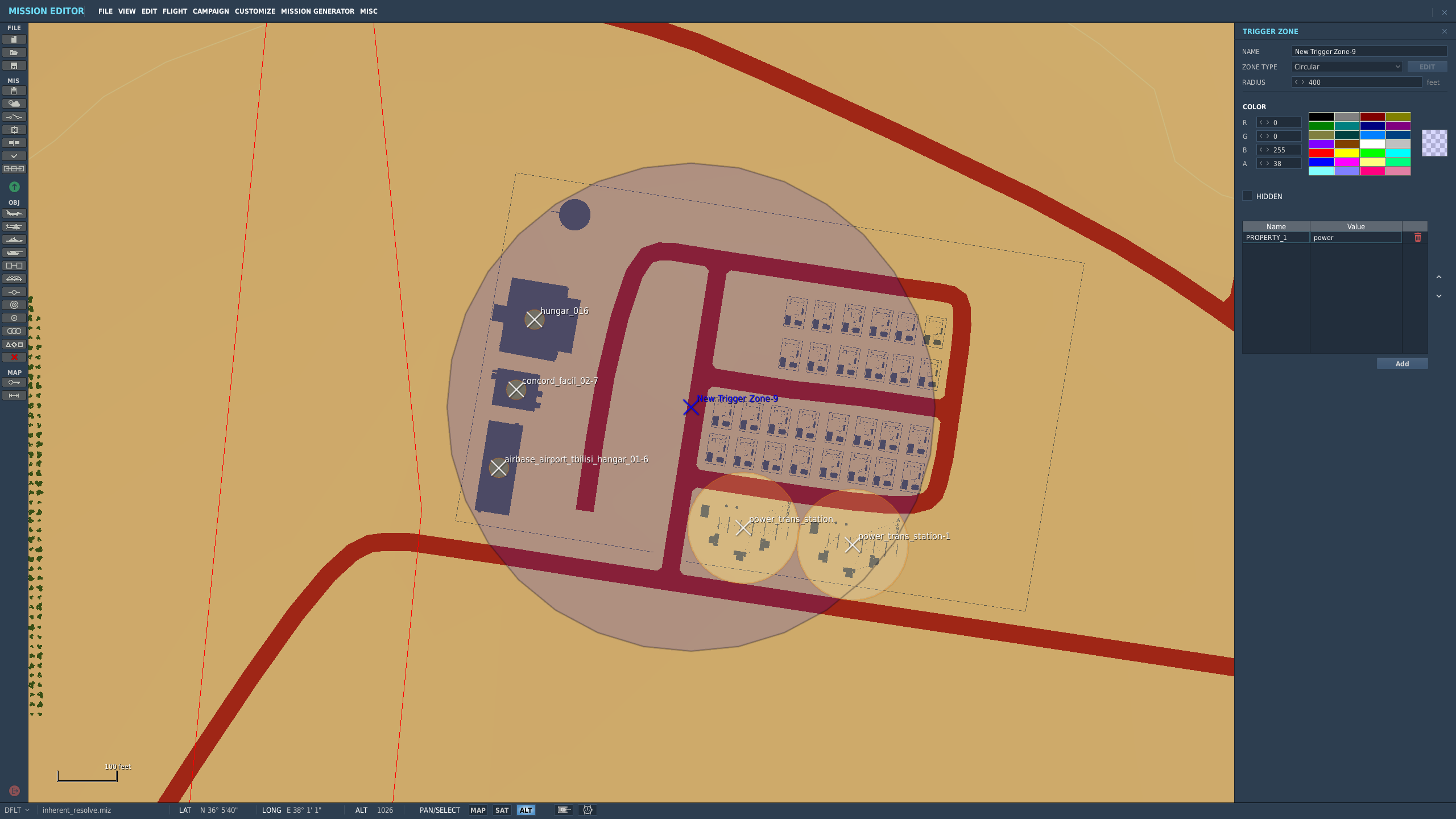
How the objective looks once in the mission planner/editor. This objective belongs to the enemy faction:
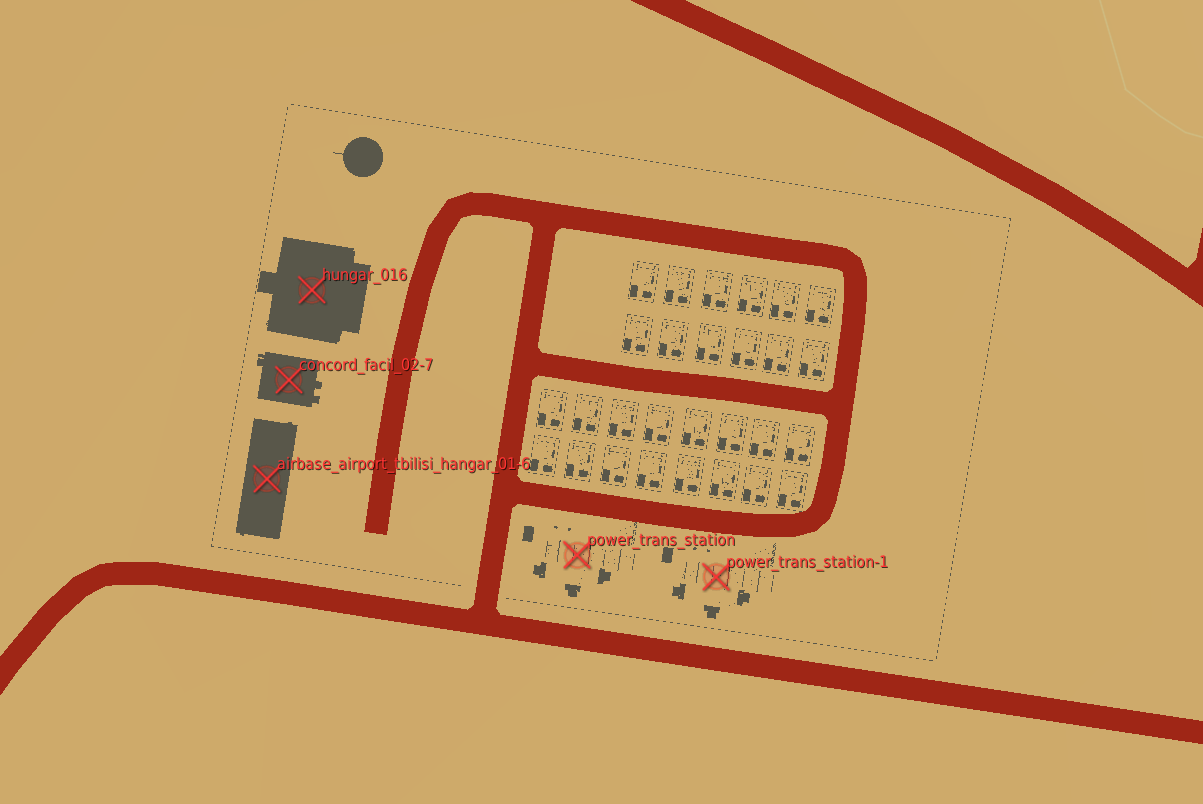
The `FactoryGroundObject` is just a special case of
`BuildingGroundObject` that we maybe don't actually need. For now it
provides some special case logic for the layout, but this allows any TGO
with the "factory" category to behave as a ground unit source.

Note that the "factory" random strike targets are *not* generated
anymore, so this doesn't affect campaign design currently.
The routes do not need be be recreated each time we create a
`FrontLine`. The front lines follow the convoy routes, which are static.
Add the convoy route data to the `ControlPoint` the way we do for
shipping lanes and have `FrontLine` load the data from there.
Removing the per-transit type supply routes allows us to find the best
route from A to B even if the unit needs to switch transit modes along
the way.

The "best" route is the one that will generate better gameplay. That is,
convoys are preferred to ships (use cases for GMT are rare in DCS), and
ships are preferred to airlift (reasons to attack cargo ships are also
rare). Avoiding airlift is also a good strategic choice generally since
it consumes aircraft that could be performing other missions.

The extreme weight against airlift in the pathfinding algorithm could
probably be scaled way down so that airlift would be given preference
over a very long trip, possibly only for urgent transfers.

Later when we add rail that will probably be given the most preference,
but possibly between road and shipping.

https://github.com/Khopa/dcs_liberation/issues/823
The simple form of this works, but without the multi-mode routing it'll
only get used when the final destination is a port with a link to a port
with a factory.

These also aren't targetable or simulated yet.

https://github.com/Khopa/dcs_liberation/issues/826
Downside to the current implementation is that whether or not transports
that were purchased last turn will be available for airlift this turn is
arbitrary. This is because transfers are created at the same time as
units are delivered, and units are delivered in an arbitrary order per
CP. If the helicopters are delivered before the ground units they'll
have access to the transports, otherwise they'll be refunded. This will
be fixed later when I rework the transfer requests to not require
immediate fulfillment.

https://github.com/Khopa/dcs_liberation/issues/825
Historically this inherited from Event but there was no reason for that.
That's gone now. Finish the separation and move the unit order tracking
class out of the combat results reaction class's file.
A CP with a factory would be able to supply itself, but was not in a
supply route if it was the only connected friendly CP. When the player
starts with only one base against an enemy base this meant that it was
in no supply route, causing it to not be a recruitment location or a
place to buy more than a reserve of vehicles automatically.
The purchase system will seek out a source for its units when the
purchase is completed. If no source is available the order will be
refunded. Orders with no source available are prevented, so this only
happens when the source was cut off from the destination during the
turn.

There's still some funkiness going on with the first turn (but possibly
only when the first turn includes a cheat to capture) where the AI buys
a ton of units somewhere other than the front line. First turn behavior
should probably be different anyway, with the first turn allowing
purchases anywhere to avoid empty front lines while troops reinforce if
the front line isn't a factory.

https://github.com/Khopa/dcs_liberation/issues/986
This also removes the "factory" type from the normal strike target
(money generating) generators to avoid confusion. Later only control
points with factories will be able to spawn ground units, at which point
these will no longer generate income.

https://github.com/Khopa/dcs_liberation/issues/986
* A Bluefor EWR 55GS in the campaign miz defines an optional EWR site. There is no distinction between how close or far it is to a base, so it's possible that there will be many EWRs within an airbase.
* A Redfor EWR 1L13 in the campaign miz defines a required EWR site.

It would be a good future idea to limit the amount of EWRs within a certain distance from an airbase. That way there's no chance of 5 EWRs all at the same airbase. Even better if there were something preventing any two EWRs from being right next to each other.

No campaigns take advantage of this yet.

Fixes https://github.com/Khopa/dcs_liberation/issues/524
Still a work in progress (the missions don't actually perform their task, just orbit). Currently:

* AEW&C aircraft can be bought.
* AEW&C missions can be planned at any control point and at front lines.
* AEW&C will return after 4H or Bingo.
Allowing these to grow infinitely leads to some really weird behaviors
when the enemy has been buying reserves long enough, where capturing a
base might result in 80 enemy vehicles suddenly at the gates.

This is just an interim fix. Ideally these units would be reinforcing
the front line as needed
(https://github.com/Khopa/dcs_liberation/issues/382), and a CP could be
lost without needing to completely destroy the defender.
If there are not airbases withing ferry range with available parking for
the aircraft then the aircraft will be captured and sold. Otherwise the
aircraft will retreat to the closest available airbase.

Fixes https://github.com/Khopa/dcs_liberation/issues/693
If the captured base has no connection to other friendly objectives (the
base was encircled) then the enemy equipment will be captured and sold.
Otherwise the units will retreat toward connected bases.

Partial fix for https://github.com/Khopa/dcs_liberation/issues/693.
Still need to fix this for air units.


