The old mode where squadrons started empty and had no size limit is
going away.

I bumped the campaign versions for the ones that claimed support and
tested a handful. All of Fuzzle's campaigns actually had the wrong
version in the yaml. They claim support for this but none that I tested
actually fit within the limits (despite having sizes defined). Either it
was supposed to be 10.7, or maybe the airports lost some parking.
It's not feasible to actually check the parking limits because we can't
identify parking limits for carriers until the theater is populated.
Doing so is expensive (and depends on other NGW inputs). Instead,
compare against the version of the campaign and guess.

A new (minor) campaign version has been introduced which makes this
required to improve the UI hint. Campaigns that are compatible with the
new rules should update their version to advertise support.

Fixes https://github.com/dcs-liberation/dcs_liberation/issues/2909.
A lot of campaigns want to define custom factions. This allows them to
do so without us having to fill the built-in factions list with a bunch
of campaign-specific factions. It also makes custom campaigns more
portable as they don't need to also distribute the custom faction files.
This field is optional. Omitting the field (or using only a date instead
of a full timestamp) will use the old behavior of picking a random
daylight hour to start the campaign.

This doesn't include any UI in the new game wizard yet. This is only a
campaign yaml option.

https://github.com/dcs-liberation/dcs_liberation/issues/2400
This will allow to automatically calculate the orientation of TGOs which are required to head to the conflict if the campaign designer has not defined a specific heading in the campaign miz. This is for example required for silkworm, scuds or some SAM systems like the SA-11.
Added the should_head_to_conflict property to the TGO
The new introduced layout system extends the mission generation so that a campaign designer can now define the heading of the ground objects which will be also used later in mission generation to orient the group accordingly. This removes the randomization of the orientation from the generation.

Most campaigns will not need any updates and will work out of the box.
- will not be used for binary read/writes (rb,wb)!
- prevents a bug where units with special characters in the unit name can not be tracked anymore as there will be a name mismatch due to wrong encoding
Used to decorate functions or methods that have save compat code for a
given major version.

```
@has_save_compat_for(5)
def foo() -> None:
    ...
```

This function will raise an error at startup if it is decorated as
having save compat for a version other than the current major version of
the game. A new major version is the definition of a save compat break,
so keeping around the old compat code serves no purpose other than
hiding initialization bugs. The compat code and the decorator should be
removed in the branch raising the error.
* Implements #1399

* Reverting accidental change in generate_landmap.py

* Changelog update

* Import beacon data for Marianas.

Co-authored-by: Dan Albert <dan@gingerhq.net>
This limit is determined by the number of buildings that belong to Ammo
Depots at the front line's connected Control Point. The limit increases
for every surviving building at ammo depot objectives.

There is a lower limit to the number of units that will spawn, so that
if there are no surviving ammo depot buildings at a control point, there
will still be some ground conflict.
Many of the schema version increases are just to add new features that
don't render old campaigns obsolete. Convert the version number to a
major/minor format so we can detect the difference between changes that
render old campaigns obsolete (major versions) and new features that
will not work on older builds of Liberation (minor versions).
This PR allows campaign creators to incorporate map objects (referred to as Scenery in the code) into their Liberation campaign.
Map objects are defined using white trigger zones created by right clicking on scenery and clicking `assign as...`. Objective groups are defined by creating a blue TriggerZone surrounding the centers of the white trigger zones. The type of objective is determined by the campaign creator, assigning the value of the first property of the blue TriggerZone with the objective type.
Map objects maintain their visually dead state by assigning a `Mission Start` `Scenery Object Dead` trigger to the trigger zone. It is important for the Liberation generated TriggerZone to be as small as possible so that no other scenery is marked dead by DCS.
TriggerZones are hidden during gameplay (DCS behavior. I don't know if it's possible to turn that off.) TriggerZones are visible in the mission editor and mission planner however. If a player is using an older plane, it is important for them to remember where the target is.
In the mission planner, the trigger zones' will be blue or red depending on which faction the map objects belong to.
Inherent Resolve campaign has been modified to integrate scenery objects.
### **Limitations:**
- Objective definitions (Any Blue TriggerZones) in campaign definition cannot overlap.
- Map object deaths in `state.json` is tracking integers. You won't know what died until debriefing.
- No images for the various buildings. In theory it can be done, but an unreasonable amount of work.
- Every blue trigger zone must have a unique name. (If you let DCS auto increment the names this is not a concern.
- No output to screen when scenery object is dead. You can see the building drawn as dead in the F10 map though.
### **Pictures:**
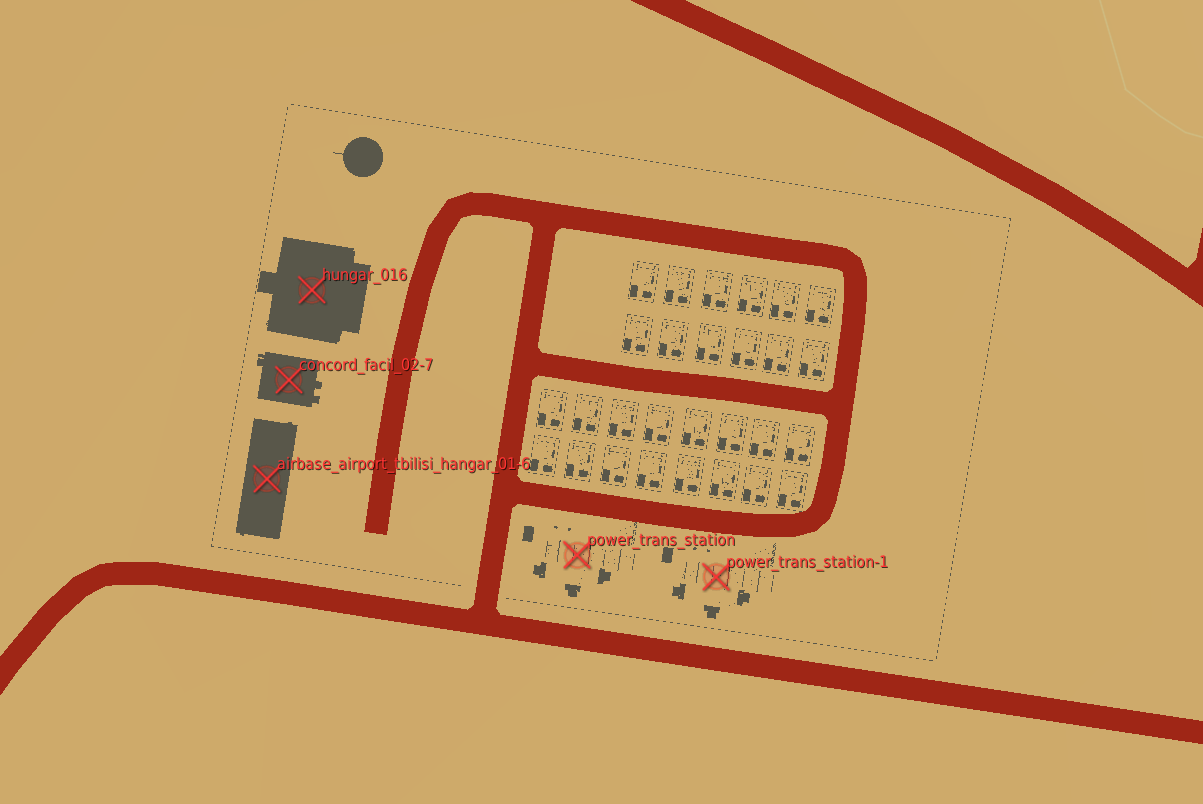
An objective:
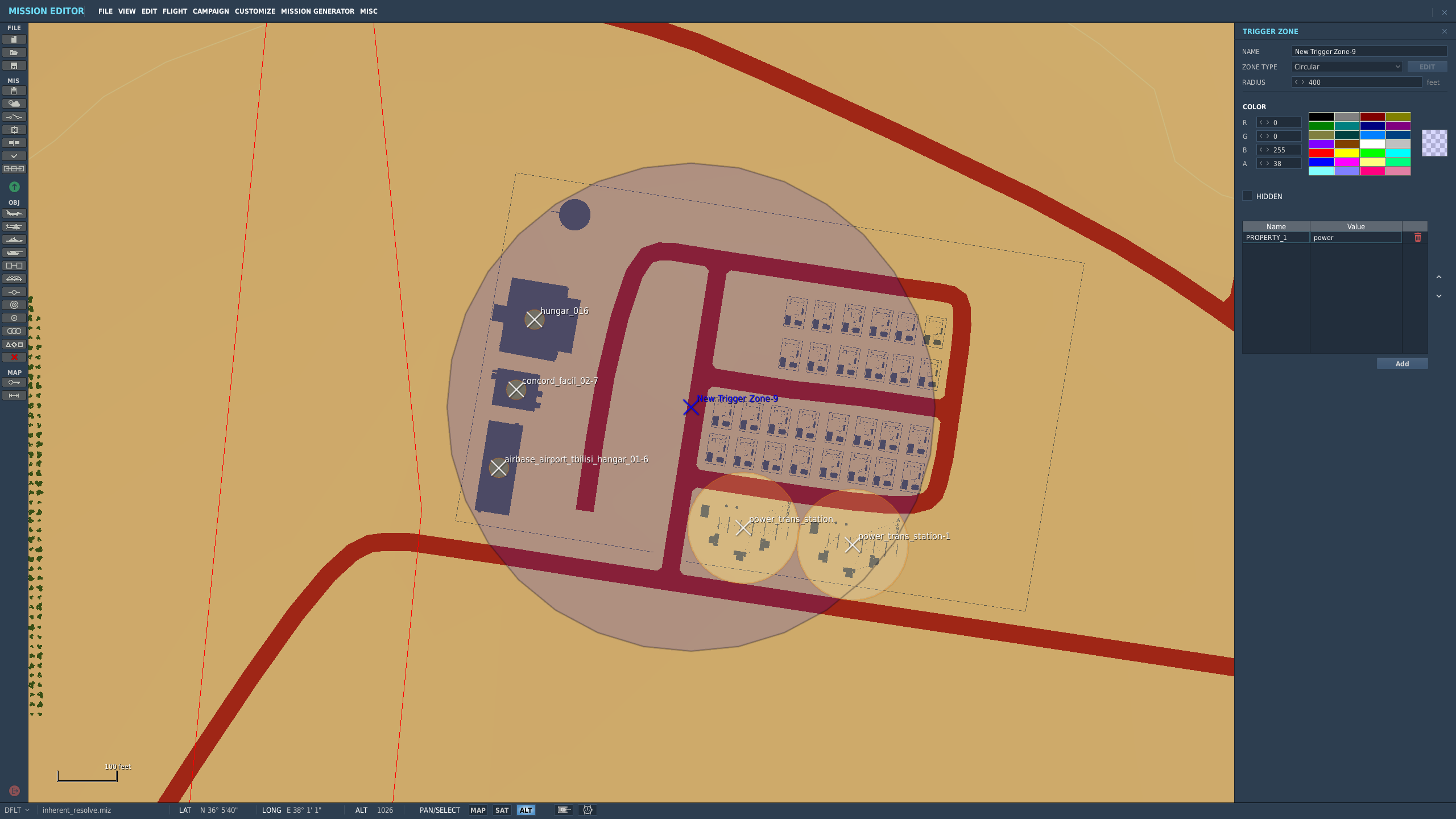
How the objective looks once in the mission planner/editor. This objective belongs to the enemy faction: