This is needed fairly often, and we have a lot of Game being passed
around to ControlPoint methods specifically to support this. Just store
the owning Coalition directly in the ControlPoint to clean up. I haven't
cleaned up *every* API here, but did that aircraft allocations as an
example.
* Addresses #478, adding a heading class to represent headings and angles
Removed some unused code

* Fixing bad merge

* Formatting

* Fixing type issues and other merge resolution misses
After completing the new game wizard but before initializing turn 0,
open a dialog to allow the player to customize their air wing. With this
they can remove squadrons from the game, rename them, add players, or
change allowed mission types. *Adding* squadrons is not currently
supported, nor is changing the squadron's livery (the data in pydcs is
an arbitrary class hierarchy that can't be safely indexed by country).

This only applies to the blue air wing for now.

Future improvements:

* Add squadron button.
* Collapse disable squadrons to declutter?
* Tabs on the side like the settings dialog to group by aircraft type.
* Top tab bar to switch between red and blue air wings.
Mod selection is now done via checkbox in the new game wizard.

The MB-339 is being turned into a paid module, and the free mod no longer works, so it's been removed.
This limit is determined by the number of buildings that belong to Ammo
Depots at the front line's connected Control Point. The limit increases
for every surviving building at ammo depot objectives.

There is a lower limit to the number of units that will spawn, so that
if there are no surviving ammo depot buildings at a control point, there
will still be some ground conflict.
This PR allows campaign creators to incorporate map objects (referred to as Scenery in the code) into their Liberation campaign.
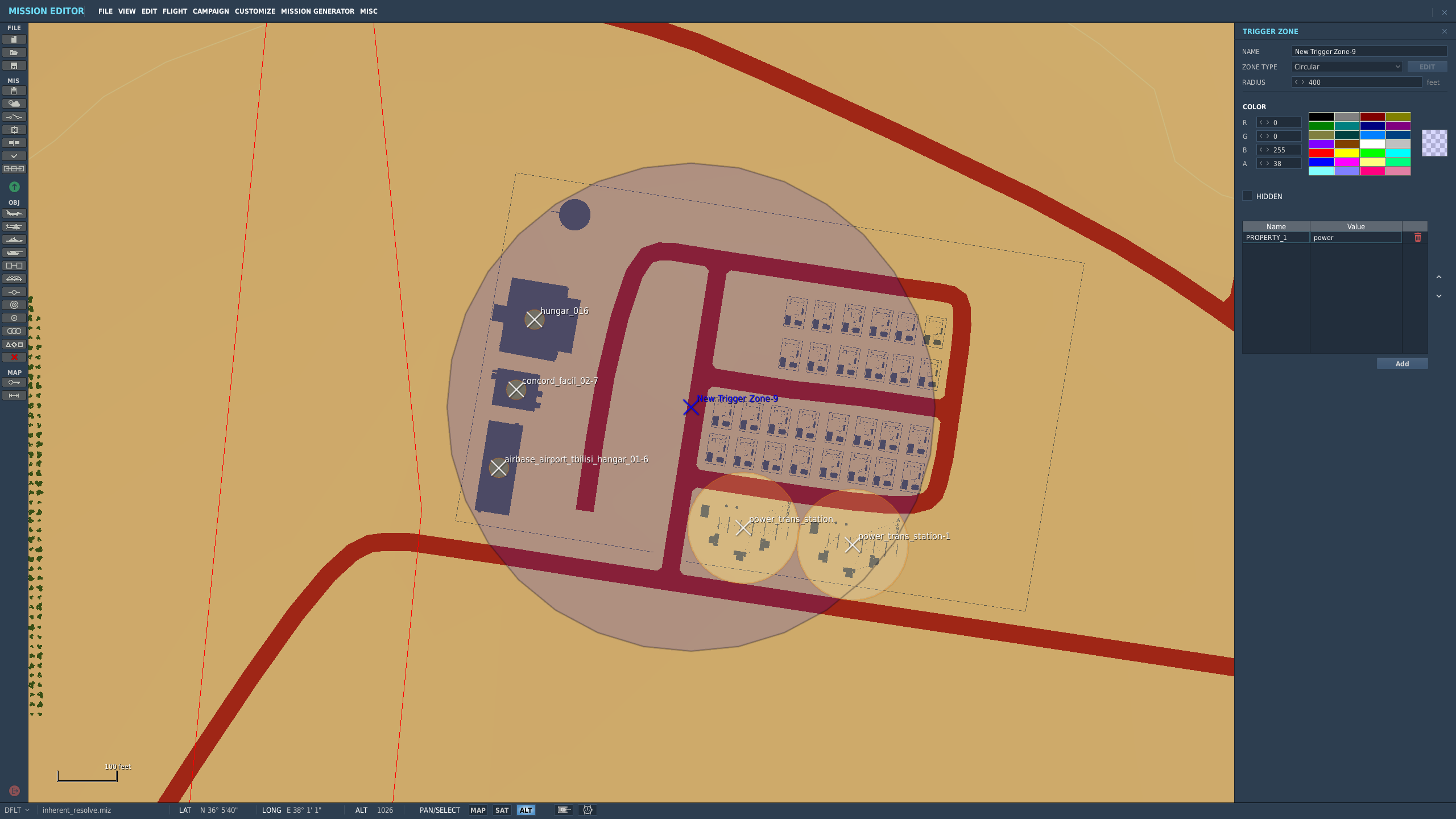
Map objects are defined using white trigger zones created by right clicking on scenery and clicking `assign as...`. Objective groups are defined by creating a blue TriggerZone surrounding the centers of the white trigger zones. The type of objective is determined by the campaign creator, assigning the value of the first property of the blue TriggerZone with the objective type.
Map objects maintain their visually dead state by assigning a `Mission Start` `Scenery Object Dead` trigger to the trigger zone. It is important for the Liberation generated TriggerZone to be as small as possible so that no other scenery is marked dead by DCS.
TriggerZones are hidden during gameplay (DCS behavior. I don't know if it's possible to turn that off.) TriggerZones are visible in the mission editor and mission planner however. If a player is using an older plane, it is important for them to remember where the target is.
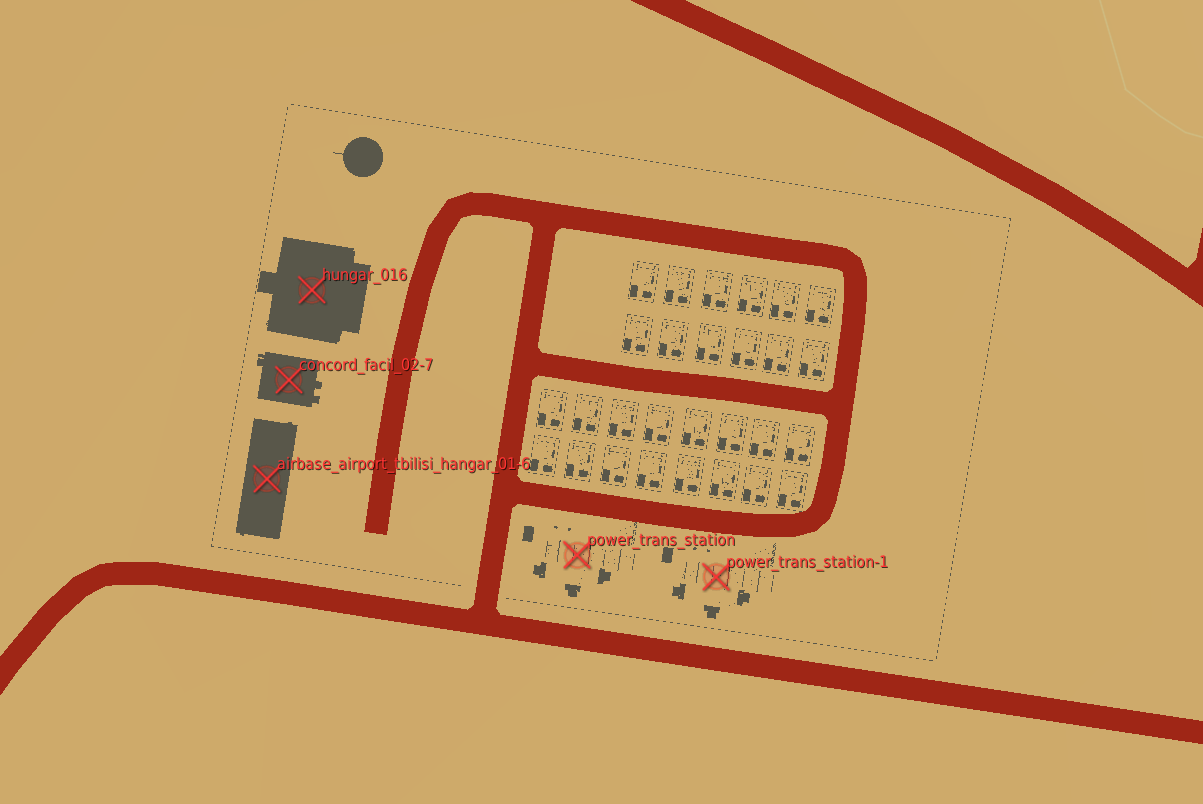
In the mission planner, the trigger zones' will be blue or red depending on which faction the map objects belong to.
Inherent Resolve campaign has been modified to integrate scenery objects.
### **Limitations:**
- Objective definitions (Any Blue TriggerZones) in campaign definition cannot overlap.
- Map object deaths in `state.json` is tracking integers. You won't know what died until debriefing.
- No images for the various buildings. In theory it can be done, but an unreasonable amount of work.
- Every blue trigger zone must have a unique name. (If you let DCS auto increment the names this is not a concern.
- No output to screen when scenery object is dead. You can see the building drawn as dead in the F10 map though.
### **Pictures:**
An objective:
How the objective looks once in the mission planner/editor. This objective belongs to the enemy faction:
Some of the objective locations for the starting front line are too
aggressive and put opfor at a disadvantage since blue ships might start
so close to their bases.
This also removes the "factory" type from the normal strike target
(money generating) generators to avoid confusion. Later only control
points with factories will be able to spawn ground units, at which point
these will no longer generate income.

https://github.com/Khopa/dcs_liberation/issues/986
* A Bluefor EWR 55GS in the campaign miz defines an optional EWR site. There is no distinction between how close or far it is to a base, so it's possible that there will be many EWRs within an airbase.
* A Redfor EWR 1L13 in the campaign miz defines a required EWR site.

It would be a good future idea to limit the amount of EWRs within a certain distance from an airbase. That way there's no chance of 5 EWRs all at the same airbase. Even better if there were something preventing any two EWRs from being right next to each other.

No campaigns take advantage of this yet.

Fixes https://github.com/Khopa/dcs_liberation/issues/524
This didn't do what it claimed to (it actually just determines the
threshold for whether a control point shoudl be a *preferred* canidate
for purchasing ground units), and the income multipliers offer the
intended behavior.
To have an effect on turn zero these need to be enabled in the wizard.
Since the last page was getting quite full I've split it into two pages:
one for the objective generation options and a second for the difficulty
and player assist options.

I also added an option to set the inital budget for opfor.
The procurement AI now uses the same system as the players. Orders are
placed and take a turn to fulfill.

This has a few advantages:

* We no longer need special case purchase logic for the turn 0
  population of opfor airbases.
* Players using auto-purchase can cancel orders they don't like.
Fixes https://github.com/Khopa/dcs_liberation/issues/473. Air defenses
for bases, strike locations, and fixed IADS will now all downgrade to
lower tier systems as needed. Strike locations will still be spawned as
an equally weighted random generator from either the medium or long
range groups, but will use a short range system if none are available to
the faction.

I've made the change in a way that leaves factions compatible, but will
follow up to clean up our built-in factions.
Mostly fixes https://github.com/Khopa/dcs_liberation/issues/473. The
last part of the fix is to migrate the `shorads` property of the faction
to just be in `sams` and just use the property to decide its use.
Currently factions like USA 2005 that have long range SAMs and SHORADs
only will still not spawn anything at medium sites because they have no
other SAMs declared.
To improve IADS design in campaigns, this differentiates required long
and medium range SAMs. SAMs that must be long range SAMs are defined by
SA-10 or Patriot launchers, while medium range SAMs are defined by SA-2,
SA-3, or Hawk launchers.

Long range SAMs positions will only be populated by long range SAMs
(Patriots and SA-10s), and not all factions have those available. Medium
range SAMs currently comprise all air defenses that are not long range
SAMs, so if the faction includes flak guns in their `sams` property then
flak guns may be spawned at medium range SAM locations.

Base defenses and random SAM locations continue to use either type of
SAM.
The AI isn't making use of these yet, but it's not smart enough to do so
anyway.

Would benefit from an icon to differentiate it on the map.

I'm stretching the definition of "control point" quite a bit. We might
want to put a class above `ControlPoint` for `AirSpawnLocation` to
represent types of spawn locations that can't be captured and don't have
ground objectives.

Fixes https://github.com/Khopa/dcs_liberation/issues/274
"Required" SAMs (designative by redfor long range SAM launchers in the
ME) will always be spawned during campaign generation. This makes it
possible to build a semi-guaranteed IADS (the exact type of SAM is
dependent) on the choice of faction.

Requierd SAMs will consume the slots of random SAMs during generation.
Later we should differentiate between strategic SAMs like SA-10s and
tactical SAMs like SA-11s so we can fill in the medium range SAMs at
random locations among the fixed long range SAMs.
When a base is captured we clear its defenses. Those locations need to
be returned to the preset location pool so they can be used for the new
base defenses.
We currently have three methods of choosing locations for TGOs:

1. From the campaign miz
2. From the per-CP mizdata files
3. Randomly

Move the selection among these sources into a single place and use it
everywhere that we search for a TGO location.

Longer term methods 2 and 3 will be removed.
Defining a campaign using a miz file instead of as JSON has a number of
advantages:

* Much easier for players to mod their campaigns.
* Easier to see the big picture of how objective locations will be laid
  out, since every control point can be seen at once.
* No need to associate objective locations to control points explicitly;
  the campaign generator can claim objectives for control points based
  on distance.
* Easier to create an IADS that performs well.
* Non-random campaigns are easier to make.

The downside is duplication across campaigns, and a less structured data
format for complex objects. The former is annoying if we have to fix a
bug that appears in a dozen campaigns. It's less an annoyance for
needing to start from scratch since the easiest way to create a campaign
will be to copy the "full" campaign for the given theater and prune it.

So far I've implemented control points, base defenses, and front lines.
Still need to add support for non-base defense TGOs.

This currently doesn't do anything for the `radials` property of the
`ControlPoint` because I'm not sure what those are.


